Me, Myself, and I – Not

Me, Myself, and I – Not

by Jane Tawel

November 22, 2017


Gordon and I are re-watching the television series, “Psyche”.  We love it.  In the last episode, Shawn insisted that he was bringing back the use of “Not!” at the end of statements to indicate that he really meant the opposite. This grammatical conceit is used as in my saying this morning, “I am going to get the house completely cleaned in the next hour -NOT!” Gus assured Shawn, that bringing back “not”,  would not be happening. And this episode aired in 2008. Fast forward to 2017, and here I am not so much insisting that I am bringing phrases like “not”, and “cool” and “psyche-out” and “radical” and “whatever” back, as much as I have never let them go.


Sometimes in moments of depression and doubt, or insecurity springing up as a downer from the high ride of pride, I am reminded that according to what I say I believe, it is not supposed to be “about me” at all.  I am teaching grammar again to students, and I am a stickler for the correct use of “I” as subject and “me” as object.  But as a wannabe Jesus follower, the truth is, I am at the best of what I was created to be when I allow myself to be the object being acted upon. It is when I start getting lost in the idea that it is “I” who controls or “I” who is right as in “right-eous”, that I end up feeling most displaced and disgruntled and depressed.

Thankfully in English, we write “I” small — only one little letter. It should make it easier to replace it with something longer, like the eternal word, Yahweh or Jehovah or Messiah.  If I would only take “I” out of my life sentences, then there could be only “He”.  And then those “life sentences” would not be an imprisonment in the egotistical-hopelessness I so often wallow in, but a “Life-sentence” of being dead to self, but alive in Christ. When I was in high school, we were asked to choose a “life verse”. I should have picked something that promised me financial blessings and a guardian angel to tote around, but instead I chose Galatians 2:20:  “For I am crucified with Christ, and yet I live.  Yet, not I but Christ lives in me; and the life that I now live in the flesh, I live by the faith of the Son of God, who loved me and gave Himself for me”. Notice that all the “I”s in this verse are preceded or followed by “nots”. Even the positive actions have to do with dying to my–self.

Now don’t even get me started on the abuse of people’s use of the word “myself”.  I think people mistake it for a fancier grammatical form of “I”, but folks, I am here as a grammar guru to tell you, It  ain’t that.  However, in my life verse, Paul, the author, could have correctly said, “Yet, not I, myself, but Christ lives in me”. There we have it.  The unholy trinity of me, myself and I,  must give way to the Holy Trinity, of I crucified in Christ, God working in me, and the Holy Spirit in my–Self.

Eugene Petersen has been a big help during these my days of Weltschmurz.  He writes in A Long Obedience in The Same Direction  of perseverance:

We survive in the way of faith not because we have extraordinary stamina but because God is righteous, because God sticks with us.  Christian discipleship is a process of paying more and more attention to God’s righteousness and less and less attention to our own; finding the meaning of our lives not by probing our moods and motives and morals but by believing in God’s will and purposes; making a map of the faithfulness of God, not charting the rise and fall of our enthusiasms.  It is out of such a reality that we acquire perseverance.(133)

Petersen goes on to interpret Hebrews 12: 1,2 this way: “Strip down, start running– and never quit! No extra spiritual fat, no parasitic sins. Keep your eyes on Jesus, who both began and finished this race we’re in.  Study how he did it. Because he never lost sight of where he was headed–that exhilarating finish in and with God–he could put up with anything along the way: cross, shame, whatever. And now he’s there, in the place of honor, right alongside God.”

I love the chastisingly ironic, hilarious way that Petersen interprets this, when he calls me out for my ridiculous complaints and whines about myself.  Petersen mocks my taking myself so seriously when he says that The Christ “put up with anything” and then lists first the cross, then shame, and finally “whatever” –showing my comparison of my “sufferings” to The Christ’s sufferings as  my little ridiculous “whatevers”.  Petersen clues right in to the fact that not only am I not taking up the literal cross of Christ, but I have somehow magnified my petty problems, insecurities and complaints to the level of the things that Jesus “put up with”. Jesus might well respond, “Whatever!”.

Perhaps I am wrong to correct my students if they use the word “me” as the subject in a sentence where God is the compound subject matter.  God and “me” can do much, much more together, than God and “I”. The life that I now live, I must live by the faith of, in, and through the Son of God.  It is time we went back to memorizing prepositions. Oh, to understand the words of St. Francis, when He prays that Christ will live out every prepositional phrase in, through, above, below, around, before, behind and within Francis’ life.  You see, Students, prepositions can never be followed by a subject like “I” but only by a direct object, like me.  And God will never insist on removing me from the subject matter of my own life, but will always offer to act in and through me as the direct object of His loving grace-filled prepositional will.


Speaking of Language Arts, though –Oh, those Germans — they do have the best words for things. God’s Word tells us that when we are approaching a time of Thanksgiving, as we are this week, but we instead feel ” Weltschmurz” or weary of the world, then we should cry out: “Inner Schweinehund!”  Inner Schweinehund is that little voice that tells you to get up off the couch, you selfish pig-hound (so much more motivating than couch potato) and do something, go running. Inner Schweinehund is just super fun to say.

Speaking of my beloved son, Gordon is in a “boot”, complete with crutches,  for a couple months, after having fractured his foot. A boot is not as cool as a cast, and I suspect they do it for profit margin — just sayin’. I might sign the black boot  in neon sharpie anyway, something, like: “Your Dad and I tried to warn you, Love, Mom”. It is a long process of healing, and for a nineteen year old, it really cramps his style (and his foot, his shoulder, his leg, his arms) — no driving, no long showers, no bike riding. So he, like so many of us in tough situations brought on by our own choices, begin to wonder, well really, who am I and what am I good for? At my age, it seems like every single day and definitely every single night,  I wonder, who am I and what am I good for?  But perhaps more frighteningly, when I wake up in the dead watches of the night, or return from the funeral of a young person, or watch people  morally implode, but mostly when I find myself  looking back and sideways and forward at the choices I have made and still make,  I more often wonder, who is God and what is He good for? When I get focused on me, myself, and I, I am content and at peace-NOT! When I lose focus on God The Father, God The Son, and God The Holy Spirit, then I am lost in the subjective subject of I and I alone. If I keep God as the Subject who acts even when I sleep then even, if not perfected, I  persevere. And I am assured in God’s promises, that perseverance is the long-game, the marathon, the way to faith, hope, love, and joy .

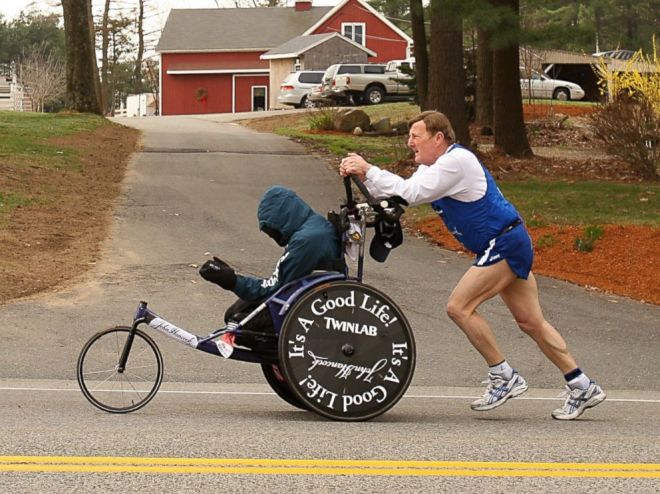
So, for Gordie and me, I recently pulled up the attached video of the Hoytes: Vater and Sohn —  and was reminded that I am not and have never, ever been the dad running a marathon  but I am always and  have always been the son who is in the wheel chair. And when I listen to this song and see the hands, and thighs, and back muscles of this father straining to push his son to the finish line, I weep, because I can see how helpless I am in life’s metaphoric wheelchair, unless I ask my Father to run the race for and in me. In this video, as in life, if I crucify myself, then the Great “I Am” can enable me to run any race this world has to offer. If I make myself the direct object of The Father’s love, then He can push me and pull me through – Whatever. It is when I see and follow the Savior whose nail-scared hands, and thighs, and back muscles pushed all of us to the Finish Line, that I have the perseverance to keep living goodness, and the experience promised peace that passes all understanding. I just need to remember that every day is a shot at winning a new Iron Woman competition, and every day, the starting line is redrawn. So I must moment by moment  ask Jesus to crucify “I”, and live in “me” and help me persevere with joy derived from His strength pushing me through in the Great Race of Life. In the video of the Hoyts’ race, look at the absolute joy on the son’s face as he crosses the finish line. That is what all those who crucify me, myself and I will some day experience when they come before the Throne, the joy of hearing from a God who did it All and pushed us through Life’s Race– saying, “Well done, good and faithful servant. Come on across your life’s finish line and receive the crown of thorns turned to a crown of Olympic Gold”.

The only reason I have ever crossed any literal or metaphoric finish line, has nothing to do with “I”, but because “me” is the direct object of God’s movement through and love in and for the world.  So, German language, take a back seat to this English teacher because Me am totally psyched out by the radical and cool love of my Daddy, Yahweh. And I say to you my silly Weltschmurz – Whatever!

I…. Not.  God…Yep-erroo!   That is how me became thankful to see some of my own handicaps today. The opposite of  “I” in God, is not “I-Not”, but You-Yes acting in me – Yes!”  That is who I am when I am best, crucified with Christ yet living powerfully and free. Because that is who God is when He is working in and through me – a good, good Daddy. That is the Thanks – giving of perseverance, the Less of me and the Yes of Christ. In German, this wholeness, and peacefulness is “ganz und friedlich”. In Hebrew, it is shalom.  In English, well, let’s just say peace in and Peace Out!

Psalm 136: 1  “Give thanks to The Lord, for He is good. His love endures forever”.

Team Hoyt and the song: “I Know My Redeemer Lives”  :

gty_team_hoyt_2008_kb_140408_4x3_992

Looking Toward Today’s Resurrection

Looking Toward Today’s Resurrection

 By Jane Tawel

March 11, 2017


Today is my birthday. It is also, the 11th day of Lent 2017.   This morning’s birthday reading was pretty spot on to rev my old engine after a week of the, I am ashamed to say, what is often a usual panoply of exhaustion and worry and work and never enough time or energy yada yada yada. Never enough embracing of joy. Never enough embracing of hope. Never enough rejection of the specters of death and a full out hug of the mysteries of resurrected life.


On this my birthday, I read Parker Palmer’s reflections in The Active Life on resurrection. So as I reflect on the march–or rather awkward Macarena– towards returning to dust today, I also awkwardly lunge and slide toward the hope of today’s Resurrection. The duality of Lent is much like having a birthday at my age – one contemplates simultaneously one’s death and one’s life as one contemplates simultaneously Christ’s death and Christ’s Resurrection.  In this dual frame of mind, on Ash Wednesday, the first day of Lent, the homily was on Psalm 103.


Psalm 103 lets us know that just as Ash Wednesday “blesses us” with the remembrance that “we are but dust”, yet we are also blessed with the remembrance of all Jehovah has done in the earth’s creation and the world’ history. We also are blessed with the hope that God’s loving-kindness endures forever for those who keep His covenant.


At my age, you begin to keep telling others and yourself that old joke about another birthday beating the alternative, and so it was with irony and conviction that I read Palmer today about this human tendency towards often living actually preferring death to life.  Jesus talked a lot about this but we keep messing up what He was really saying.  I keep messing it up. So I want to share the words of greater thinkers than I. Palmer writes about a poem by Julia Esquivel.


“They Have Threatened Us With Resurrection”

by Julia Esquivel


It isn’t the noise in the streets

that keeps us from resting, my friend,

nor is it the shouts of the young people

coming out drunk from the “St. Pauli,”

nor is it the tumult of those who pass by excitedly

on their way to the mountains.


It is something within us that doesn’t let us sleep,

that doesn’t let us rest,

that won’t stop pounding

deep inside,

it is the silent, warm weeping

of Indian women without their husbands,

it is the sad gaze of the children

fixed somewhere beyond memory,

precious in our eyes

which during sleep,

though closed, keep watch,

with each contraction

of the heart

in every awakening.


Now six have left us,

and nine in Rabinal, 1

and two, plus two, plus two,

and ten, a hundred, a thousand,

a whole army

witness to our pain,

our fear,

our courage,

our hope!


What keeps us from sleeping

is that they have threatened us with Resurrection!

Because every evening

though weary of killings,

an endless inventory since 1954, 2

yet we go on loving life

and do not accept their death!

They have threatened us with Resurrection

Because we have felt their inert bodies,

and their souls penetrated ours

doubly fortified,

because in this marathon of Hope,

there are always others to relieve us

who carry the strength

to reach the finish line

which lies beyond death.


They have threatened us with Resurrection

because they will not be able to take away from us

their bodies,

their souls,

their strength,

their spirit,

nor even their death

and least of all their life.

Because they live

today, tomorrow, and always

in the streets baptized with their blood,

in the air that absorbed their cry,

in the jungle that hid their shadows,

in the river that gathered up their laughter,

in the ocean that holds their secrets,

in the craters of the volcanoes,

Pyramids of the New Day,

which swallowed up their ashes.


They have threatened us with Resurrection

because they are more alive than ever before,

because they transform our agonies

and fertilize our struggle,

because they pick us up when we fall,

because they loom like giants

before the crazed gorillas’ fear.

They have threatened us with Resurrection,

because they do not know life (poor things!).


That is the whirlwind

which does not let us sleep,

the reason why sleeping, we keep watch,

and awake, we dream.


No, it’s not the street noises,

nor the shouts from the drunks in the “St. Pauli,”

nor the noise from the fans at the ball park.

It is the internal cyclone of kaleidoscopic struggle

which will heal that wound of the quetzal

fallen in Ixcán,

it is the earthquake soon to come

that will shake the world

and put everything in its place.


No, brother,

it is not the noise in the streets

which does not let us sleep.


Join us in this vigil

and you will know what it is to dream!

Then you will know how marvelous it is

to live threatened with Resurrection!


To dream awake,

to keep watch asleep,

to live while dying,

and to know ourselves already

resurrected!


In my 7th grade English classes we have been studying poetry.  You would think they would moan, but they really get into it – reading it, dissecting it, and writing it. Here is one thing I resonated with that Parker says about his finding his way into the meaning of Esquivel’s poem:


The longer that one dwells on the poem, the harder it is to say exactly who threatens us with resurrection. The poem itself is like the kaleidoscope whose image Esquivel uses; each time you turn it a new pattern appears. So the poem imitates life, in which the “threat of Resurrection” comes both from those who dispense death and from those who have died in the hope of new life… If it is true that both the killers and the killed threaten us with resurrection, then we, the living are caught between a rock and hard place.  On the one hand, we fear the killers, but not simply because they want to kill us.  We fear them because they test our convictions about resurrection, they test our willingness to be brought into a larger life than the one we now know. On the other hand, we fear the innocent victims of the killers, those who have died for love and justice and peace. Though they are our friends, we fear them because they call us to follow them in “this marathon of Hope.”  If we were to take their calling seriously, we ourselves would have to undergo some form of dying.  (Parker 147-8)


It does take time to figure out meaning – in poetry, in literature, in science, in nature, but ultimately in one’s life. I am very grateful on this my birthday to have had so much time to try to figure it all out.  And I ask forgiveness for wasting so much time on anything that does not enflame hope, kindle truth, and stoke life– in myself and in others. Because that is what defeats death. Faith, Hope, Truth and Love are those eternal “dust-busters”. And they are available for each day’s embrace of Resurrected Life.


Our spiritual journey is one of testing and running.  We are put to the test daily to “figure out what it all means”. And we must run and not grow weary in hope. The paradox as St. Paul found, is that in Christ’s powerful death is also Christ’s powerful Resurrection Life. Lent is a reminder that we take up Christ’s cross daily in order to experience daily the Hope of Resurrection – His and Ours.


May today be a day when we embrace the journey of finding the meaning of our own daily deaths on our journeys to today’s possibilities for our own daily resurrection. The Good News threatens the world not with death, but with Resurrection and the hope of Christ’s resurrected life.  May today be a day when we too are threatened and threatening with resurrection.


How To Celebrate Sorrow

How to Celebrate Sorrow

By Jane Tawel

February 26, 2017


Wednesday, March 1 will be one of my favorite days in the year.  It is Ash Wednesday, a day  where some of us who believe in Jehovah, the God of Israel, the God of The Christ,  begin forty days of penitence. The Jews celebrate Rosh Hashanah. (Note to self: The Muslims also celebrate these same days of repentance.) At the end of these various religious days of repentance, there is a big celebration:  we call it, Easter or Resurrection Sunday.  The Jews call it Yom Kippur.

So I am meditating on the fact that I seem to have been born into a time and place where the idea of penitence, remorse, regret, sinfulness, unholiness — all of it — is “not a thing”, as  the kids say. Perhaps born out of time and place, I am trying to make it “a thing” — a daily “thing” in my own life. I walk and pray and try to accept a daily sense of my need to be cleansed from “stuff” inside and outside, in my mind and in my heart.  The bible I read, calls it a sense of my own unrighteousness and need. And being redeemed has to do not only with eternal salvation but with relationship to a specific and real God and relationship to specific and real others — my neighbors which Jesus says include my enemies, as well as my family members, biologically family or Christ-0logically family.

The first time I experienced someone who celebrated Ash Wednesday was when I was a freshman at Wheaton College in Wheaton, Illinois.  My beloved theater professor, Jim Young, came to class with a large black smudge on his forehead and I, being ignorant of the meaning, kept trying to rub it off for him.  He recoiled in horror from my little anxious helping hand.  Jim is no longer wearing ashes; he is now on the other side of Resurrection Sunday forever.

I often think of that metaphoric moment and how it reveals continual issues in my own life.  I have grown up in a culture that does not want to look at negative things too closely and does not want to live in grief much at all. We want to move straight on to the celebration.  We want to helpfully and quickly remove the “smudges” from our own lives and the lives of others. We want to “bury the past” and “bury the body” and be happy again.  We move past the moments of sorrowful deaths, both the literal ones and figurative ones, as quickly as possible.  There is not enough time to grieve or mourn, there is too much to do and accomplish, and staying busy and active helps us “get past” the problems and sadnesses in our souls.  And what good does it do any one anyway?

The only problem is, all of that reasoning just isn’t true. We know it isn’t true somewhere deep inside. And when we keep living by denying the smudges and moving on to the resurrection of our own happiness, we end up with ever larger and larger holes in our souls and confusion about why we aren’t all that happy. We merely bury the live body of ourselves along with the dead bodies of the other person, other relationship, other job, other life.  We move our bodies along, but our souls begin to rot from within, merely masked in the myrrh of merriment. We refuse to go through the needed completeness of penitence and grief, a daily need, as Jesus told Nicodemus, to go through the painful channel of suffering and be reborn into new life. We want Jesus to have suffered for us on the cross so we can wash our hands and souls of a need to suffer with Him on behalf of our own broken lives and the lives of others.  We want to avoid going through the Red Sea and wilderness and arrive in the promised land with all our “stuff”, saved and cleansed by someone else’s journey, while we sit and watch, grumble and criticize, and devour the panacea of false hopes and happinesses. We want the fruit from that tree not the one we were provided — partying continually, eating, drinking and being merry, and never finding the joy that comes with the hard work of penitence and deprivation, fasting from self-love in order to find the love beyond measure in our Heavenly Father and the selflessness of a reborn soul.

In the bible, numbers matter and forty and ten, the days of Lent and of Rosh Hashanah respectively are days of completeness.  At the end, of both of these times, I don’t end up with a better me, like I might after a diet, but I end up with a better sense of who I am in the vastness of eternity and worlds without end.  I end up not less penitent, but more humble and thankful to be alive, more thankful to a God who loves enough to suffer and grieve. I end up closer to shalom, or true soul-wholeness, and with a better relationship with a real God, and a better relationship to the reality of this world and my neighbor. I end up with an inkling of what completeness might really mean. And that is how sorrow leads to celebration.

This Lent, I am sharing with folks that I will be “fasting” from Facebook.  The reason I am fasting from it, is because I keep anxiously and falsely thinking that I can be “helpful” — I am wired to be busy, busy, busy as a teacher, a parent, a friend.  I have been reading a book by Parker Palmer and this week’s reading was about the days of “Lent” for Jesus — The Forty Days in the Wilderness– days when Jesus met head- on complete fasting and complete temptation. The One Who Was Sinless came out from those days of deprivation and temptation with a better relationship with a real God and a better relationship to the reality of this world and His neighbors, including His enemies.  Jesus came out of those forty days with more grief and more joy and began the business of saving the world. And in The Christ’s ministry of sorrow and suffering, we all get a better chance at celebrating.

One great thing about writing a blog, is you get to connect with other writers.  I have realized that anything I have to write, has been written better by some one else, but I also realized that I simply am one of those people who must write to think and process.  I encourage any of you readers who want to take a journey into a less unfulfilling -self-centered life and a more fulfilling, other-centered life of “being”– a life where a true lenten season and a daily sense of grief and repentance and a conviction of one’s own need and want is a path to a true sense of completeness or shalom– where a time of repentance and taking up Christ’s cross leads to true joy– I highly recommend you read some of the great writers on these topics. There are many. If you haven’t read the bible for yourself, check it out along with those who can illuminate it for you. Recently,  Parker Palmer and Henri Nouwen have provided a huge paradigm shift for me. I encourage you to read them.  Here is the passage from Palmer that has given me an idea of how to fast and celebrate Lent this year.  I look forward to celebrating with you on Facebook on the other side of the next forty days. God willing.  Here’s to ashes!

From The Active Life  by Parker Palmer:    on fasting,  temptation, and the need to prove ourselves:


In the first temptation Jesus faces, the devil says, “If you are the Chosen One, tell this stone to turn into a loaf.”  But Jesus refused him…. But these word of Jesus, his refusal to turn stone into bread, are his response to the devil, not to starving people. Once Jesus moves through these temptations and embarks on his public ministry, he works a number of miracles, including the provision of bread for people who are hungry. What Jesus says and does is related to context, and when the circumstances are right he has no inhibitions about using his powers to meet authentic needs.  We need only to understand why the circumstances in this story were wrong.


The devil prefaces his challenge to turn stone into bread with a taunt that takes a very familiar form:  “If you are the Chosen One…Though few of us get needled for thinking we are Chosen, the tone of that taunt should remind us of outward or inward voices in our lives: “If you are so able… “If you are a real woman or man…” If you truly care…” If you are such a good parent…” The root temptation here is almost irresistible.  It is not the temptation to do a magic trick, which most of us know we cannot.  It is the temptation to prove our identity, which many of us feel we must…


Had Jesus made stone into bread simply to show the devil that he was the Chosen One, he would have been acting mechanically, caught in the cogs of cultural expectations, compelled by circumstances to act a role.  By refusing to do so, he both demonstrates and extends his transcendence over the context of his action….Jesus does not regard himself as accountable for his calling to any voice except God’s so in his refusal to “prove” anything to the devil he is actually proving that he is the Chosen One…


When you refuse to meet the terms of an external demand, refuse to produce publicly verifiable results, you do not prove anything in the normal sense of that word.  Instead, you leave yourself open to charges of elevation or cowardice, and you forfeit the external confirmation on which so many of us depend; you may become inwardly shaky about who you really are. …


In light of the fact that Jesus had been fasting in the desert for an extended period of time, “and at the end he was hungry,” the devil seems to speak with a voice of reason, perhaps even compassion, when he says, “… Tell this stone to turn into a loaf.”  Henri Nouwen calls this the temptation to be relevant, and with that word he names something that many of us face from time to time—the temptation to “solve” some problem on a level that does not solve it at all, and may even make things worse.


Jesus’ real problem in the desert is not hunger—though it might look that way to an outside observer—so his real solution is not bread…   when the time comes to end a fast, you do so gradually, and not devour a chunk of bread! When we rush to the aid of a fasting person, attempting to be “relevant” by insisting that he or she eat, we are likely not only to be irrelevant but to do harm as well.


True relevance requires a certain subtlety, which the very idea of relevance seems to exclude. What Jesus really needs in his desert fast is not food.  In fact he does not need anything external.  Like the woodcarver in the poem, who fasted not merely from food but from praise and criticism, gain and success, Jesus’ real need is for inward confirmation of his mission, a confirmation he is more likely to find in the emptiness of fasting than in the gratification of bodily needs…..


Actions that seem relevant may turn out to be irrelevant in the extreme. Parents know that they do not necessarily solve a child’s problem by giving in to the demand for a special toy. They must address the problem behind the problem, which may be the child’s capacity for delayed gratification or for simple self-reliance.  Teachers know that they do not necessarily solve a student’s problem by answering the questions the student asks.  The real question may be the student’s ability to find answers for himself or herself, so the teacher who withholds answers may enlarge the student’s capacity to learn.  The temptation to be relevant is often the temptation to deal with only the external illusion of a problem and ignore its internal truth. (Palmer, The Active Life, excerpts from pp. 106-108)

photo-3

Traveling Dreams

Traveling Dreams

May 10, 2015

By Jane Tawel

For my children on Mother’s Day: Keep in The Dream Way


selfdriving_5350

I had one of my traveling dreams last night. I have always had traveling dreams and they are always stressful, slightly scary, and silly, and pretty easy to analyze.


In my traveling dreams I am always trying to get somewhere. It is always dark, even if it is happening in the daytime. I am always driving or being driven somewhere in a car of dubious merit. Since becoming a parent, I often have my children with me. I am almost always lost and can’t find my way. Told you this would be easy to analyze.


In my traveling dream last night, my cousin Emily was driving and I was in the passenger seat. We had another woman with us in the back seat who was a friend or second cousin twice removed sort of person. She was a Ginger. We were trying to get somewhere so Emily could catch a plane. We were travelling all those little back roads and highways that used to be so common in the Midwest but every once in a while we would hit a terrifying freeway and have to get off. I took over driving and got lost and pulled into someone’s driveway to turn around. We ended up in a small town and the police started following us, then another police car came along side and pulled us over. They made us get out of the car. They thought that we were kidnapping the ginger-haired girl in the back seat. The female and male cops pulled the unnamed Ginger second cousin twice removed aside and then asked Emily to tell them the first name of the girls’ father’s father. Neither of us knew it though we racked our brains trying. Even though we didn’t know the name that would prove we knew the Ginger and were not kidnapping her, for some reason unexplained to us, the cops realized we were not kidnappers and let us go. We went to a cafeteria line where suddenly my cousin Amy and my sister Janet appeared and the second cousin twice removed disappeared. I put a plastic container of salad with edemame beans on my tray. Emily asked for the two taco plate. I decided I wanted tacos as well but did I still want the edemame salad? Emily insisted she was treating all of us. The dream ended before I knew what I decided to eat.


Sometimes all you can say about a dream, is “Life is like that.”


Life is full of choices. In life, you are always trying to get somewhere. Life is confusing and you often feel lost. You have companions on the way, some known and loved and some that are just along for the ride. Bad things do happen to good people and good people do often do bad things and sometimes the cops catch the wrong people and sometimes the bad people get their just desserts and sometimes the cops don’t show up at all. Sometimes the cops in real life actually shoot you dead for no reason. And some times the cops get shot dead for no reason. Just like in their nightmares. And Life is like a dream because we so often are just asking, “why did that happen?” and we are in it having to keep driving forward without ever knowing how it ends. Ever try to get back into a dream after you wake up and find out how it ends. Life is like that.


Sometimes, in real life just like in dreams, we seem to have no idea how we got to the place we find ourselves in. It is often because we weren’t paying attention to the choices we made when we started that particular journey. Just like in dreams, suddenly you are there. Sometimes we end up somewhere in life because we are dreaming when we should have been paying attention to what we were actually doing at the time. “Did I leave my keys in the car when I locked it?” — sort of attention deficit things.


The end of a day or a month or year is sometimes like waking from a bad dream because we got lost on the way. Sometimes we push the gas instead of the brakes or the brakes instead of the gas. Life is stressful because we just keep driving even if we don’t know how to get to where we think we want to arrive. We often refuse to stop and ask directions.


And Real Life is always slightly scary, at least once you take the wheel of your own life. Life was much less frightening when your mom was driving you home and whenat the end of a day you found yourself snuggled up against your parent in a warm bed after a large meal and a cup of cocoa.


Also, to be honest, our lives are frankly always a wee bit silly. Most of our life’s journeys should be relegated to the “I went to Target and the post office today” sort of journeys, not the crossing the Rubicon or the “It is a far, far better thing I do” sort of journey. But then since none of will know until the next life, the true meaning of each day’s journey, we should never image that our silly selves are not somehow also living out an epic journey full of unseen battles and quite a few seen ones.


If you read some of the great books that show in equal parts, humans as God-imagers and frailly ridiculous beings, you get a better idea of how spectacular and silly we all are. We are heroes unawares. Explore characters like those in Lewis’ Space Trilogy, Tolkien’s Lord of the Rings, or Anne Tyler’s or Jody Picoult’s women heroes and you will hopefully see humanity in a light that our dreams often try to reveal to us.   I am not talking here about the brokenness / heroic element in a Sydney Carton or a Billy Pilgrim. I am talking about tilting at windmills and a thumb to hold back a flood. I am talking about flying dreams and being famous dreams. I am talking about silly disciples walking with The Christ and arguing about who gets what chair near the future King’s throne. And Jesus responding by both laughing at their silly hubris while recognizing the heroic efforts to follow God that lay around the unseen bend for these human beings. Jesus must have some good chuckles at our silliness as we slap-stick through Life. And yet, just like the disciples who confused gaining a throne without carrying a cross, God has an inexplicably dream-like desire to help us humans drive towards the brink of heroism. Sometimes, we even leap over the chasm of “quiet lives of desperation” into something gloriously God-like.


I am talking about Life not as a linear attempt at accomplishment but as a traveling dream. I am talking about dreams in real life if not necessarily what we consider real time and place.


Dreams always have their own sense of time and place but aren’t usually what we consider factual time and place. Quite often they do not end up how and where we imagine they will or should. In this way our dreams illuminate something of God’s view of time and reality. A dream begs the question, what is Reality? Am I seeing this as it is? Is the meaning of what is really going on inside me more revealed when I am awake or when I am helplessly, innocently asleep?

 df9843885fa768b0d3ebaa54d3701b2e

I like to mess with my husband about my Native American heritage. If you know anything about the Native Americans you know that dreams are an important part of their belief system, much like they used to be for Judeo-Christian folk in the Bible. The Native Americans believe that it is your soul that dreams dreams, not your mind or your body. In this philosophy, life is one big Dream and in that the impermanence of this life is recognized. Steven Bancarz writes of Native American philosophy, “It is by experiencing the realness of the dream world that we appreciate the dream-ness of the real world”.[1] The Bible talks about the reality of dreaming versus the reality of what we imagine is only in our waking this way: It will come about after this that I will pour out My Spirit on all mankind; And your sons and daughters will prophesy, Your old men will dream dreams, Your young men will see visions. (Joel 2:28)


Eugene Petersen in his book Tell It Slant, talks about Christ’s use of apocalyptic language. Petersen notes that Jesus uses stories to reveal to us Kingdom reality which is not a future apocalyptic dream or a past historical accomplishment, but a present reality behind an almost dreamlike curtain of the world we try to see with fallen eyes. The kingdom world can often only be approached not with eyes wide open but through eyes closed, as in sleep, to the oncoming traffic of the world and open to the dream world that exists just beyond our consciousness. Just beyond our small egos.


Much like the telling of dreams, Jesus’ stories are not easily understood nor analyzed. Parables have a dreamlike quality because they reveal the world behind the curtain. When Jesus is telling the story of the widow and the judge in Luke 17:20-37, Petersen writes,“he does it by introducing a radical reorientation on the nature of time and place, kingdom time and place.” Peterson goes on to say, “Jesus is training our imaginations so that we will be able to participate appropriately in the great salvation drama that is taking place right now – not world events of the future but the presence of the kingdom right now. Apocalyptic is a language strategy for breaking open awareness of the tremendous energies of good and evil contending with one another beneath the apparently benign skin of the ordinary.” [2]


Apocalyptic language gets our attention, like a dream might abruptly wake us from sleep. Apocalyptic awareness says, “Repent”, which is another way of saying “Turn around, you are driving the wrong way.” Apocalyptic awareness, like a dream, reveals what is under the surface of our world and often wakes us up to a different reality.


It is like the first time you reach out your arms to hold your newborn child. Though it seems like a dream after all the planning and striving and fears and work and hopes, your deepest being knows immediately that reality will never be the same again. You will no longer see reality as you did before you became a parent. The world has changed forever. You have turned a corner and the road will lead you in a whole new direction. And you are desperate every day thereafter for the rest of your life and his or her life, to find a perfect map that will take you and the most precious being in the world in the right direction. So she will be safe. So he will be fulfilled in a career. So she will find the right soul mate. So he will be brave in the face of disaster. You scour maps so you can help this new little entrusted life drive the straight path and find The Way.


There are many options today for getting directions. I am old enough to remember the giant tome called The Thomas Guide that was your traveling bible when you moved to Los Angeles. Today I prefer Mapquest, but my children swear by Googlemaps. All religions promise to provide a life map. The Judeo-Christian Life-map is revealed in the Scriptures, the lives of those who have tried to follow the Life-map, and in the Life of the Son of God who came to live the Life-map to the fullest. Early Christians first called our Life-map simply, “The Way”. Now we often get a bit lost in what we think is Christian Reality and we start calling The Way things like theology, Arianism, Calvinism, Wesleyanism, hermeneutics, and Vacation Bible School. These often help but they often simply encourage us to define other humans as going the wrong way. Sometimes all the technologies and labels and secure findings trap us in a sort of Christian couch potato life, watching Rick Stevens live the journey while we only talk about it. Not travel it.

 2010-06-03 14.11.06

I fear sometimes with all my knowledge about The Way, that I have lost the joy in the journey on The Way. I think I know where I’m going but it’s just in my head. It’s a dream, not a reality of living in The Way.


Remember when you were a kid and you just hopped in the back of the car and let your parent drive you someplace. Even if the place had a name you recognized like Grandma’s house, or The Mall, how you actually got there was always a mystery. You couldn’t see much as your little child self, looking out the back seat window. But you weren’t afraid, because Dad was driving. Mom was reading the map and telling Dad, “no you missed the street, turn around.” Your sister was pulling your hair and you desperately had to pee but didn’t want to tell the parents because then they’d pull over and make you crouch behind a bush. So you looked out the window, tried to avoid your mean sister, and trusted you could hold it long enough so that Your Parent could get you to Grandma’s bathroom.


The Way is best traveled if you sit in the back seat, hold on, enjoy what you can see out the window, avoid the mean sisters, and let Your Parent drive.


The Way. Sometimes when I read about The Way or hear about people who have lived The Way, I think I must be dreaming. Who could live like this and get any where? I mean it can’t be real. You must be dreaming to think you can live out The Way on this earth, at this time, in this place, with these people, with that going on, with all the this and that and those. You are living in a dream world, girl friend to think you can do what Jesus did, follow God’s instructions, trust the Holy Spirit. Get a reality check, dude. Smell the coffee, honey. Wake up! Jane, ole thing, you gotta get in the driver’s seat, sit up front, take control of the wheel, and never stop to ask for directions or turn around and start again. Don’t admit defeat, don’t admit you are lost. Just drive, girl, drive!


“Trust in the Lord with all your heart, soul, strength and mind, and He will direct your path.” Prov. 3:5,6


I am The Way, the Truth and the Life.” – Jesus –John 14:6


This is what the kingdom on earth as in the heavens, looks like. Kingdom Life is a dreamlike reality, open to our imaginations, beating on our hearts like an unseen guest at the door, alive in the souls who do not crush the dream for a blind, tasteless portion of “reality”. The journey towards the Kingdom is full of adventure, full of choices, full of bad guys and good guys, and filled with moments of heroism and moments of hubris. Just like the journey of childbirth or adoption, Life is full of pain and angst and fear and bad choices and good luck and you would do it all over again because at the end you get a prize.


At the end of childbirth, you get to see that little face and you know that every step of that hard dreamlike journey was worth it. You dreamt about this moment of having a child for so long and at last you know the real meaning of what it means to be a parent.

 327276_268797216484421_1753974164_o

At the end of Life’s Journey, Jesus promises a prize. We will see the face of our Savior. And the real meaning of the dream of this chimeric world, will be gloriously revealed to be something similarly dreamlike and really quite different after all. And that is why following the Life- map of The Way is worth every thing. For what does it profit me if I gain the whole enchilada, but lose my soul’s way? What profit is there in gaining what I dream I want if I lose the reality of what God wants for me?


Have you heard that theory that we never actually die in our dreams? That we always wake up before we hit the ground, or get run over by the bus or crash the car? That is the promise of Christ’s dream if we follow The Way. We will never die but simply wake from what we thought was reality, to find it was always only a dream.


Once upon a time a young woman named Caitlin, saw her boyfriend named Raoul, take off for California to work for JPL. She stayed behind in Boston, a city she loved and where she had acting gigs and friends and a free place to live. It was also where she began calling herself Caitlin instead of Jane because it would make her famous enough to achieve her dream of getting on the Johnny Carson Tonight Show as a famous actress (Did I mention she dreamed of being famous?).


But a funny thing happened after Raoul had been gone for three months. Caitlin began to miss Raoul. She began to dream of him. So Caitlin hopped in her un-airconditioned Mazda GLC Hatchback and with Triple AAA flip-maps on the passenger seat, began to drive all the way across the big ole’ country of the United States of America. No GPS, no cell phone, no laptop, no gmail, no companion. Just Caitlin and her AAA maps. She made it to her mom’s house in Indiana for some loving and free food. She made it to her Uncle Marlin and Aunt Sally’s house in Kansas City. The morning Caitlin left, Uncle Marlin snuck out and filled the tank with gas and the tires with air and the whatcha ma thingy with oil. Aunt Sally snuck a packed lunch with cookies for dessert into the back seat.


Our heroine Caitlin got seriously lost in Omaha but eventually turned around and found her way. A flat tire made her swear. Once when she stopped at Wendy’s for lunch, she left her watch that her grandma had given her, in the restroom and someone stole it before she went back and could retrieve it. That watch was gone forever and it still makes her sad.


When Caitlin finally hit Phoenix she was a bit bedraggled and shell shocked and did not at first compute that it was blizzarding in what she had assumed was a part of the world that was always hot. Caitlin thought she must be dreaming. She managed to pull of the road in time to buy the tire chains but when she got to the part of the road that said “no tire chains, no go”, she was defeated. So she sat in her little tin can of a car, a bit teary for a heroine, who was going many miles for her man. Then an angel of the Lord dressed up like a trucker stepped out of a chariot that looked like an eight-wheel semi, and said “Fear not, I bring tidings of great joy!” And he asked if he could help. Caitlin never saw that trucker again which proves he was an angel.


After two nights in a Motel 6, our heroine Caitlin, outlasted the Evil Blizzard and began the terrifying trip flying on the dragon’s back of The 10 and The 210 into Los Angeles County. She arrived, eyes still stuck open with fear after her first near death experience with LA traffic, and she stepped out onto the sidewalk of Brent Avenue, South Pasadena. Caitlin realized as she stood, her legs numb with days of straight driving, that she was getting wet, and thought that it must be raining, not realizing it never rains in California. She was instead, standing in her first ever sprinkler system.


Behind the warmly lighted windows of the ground floor apartment, the inhabitants must have sensed the heroine’s presence. Out of the door flew Sophia Fifi Caesar, and Scott Warner, and their newest housemate, Raoul Tawel. And when Caitlin saw her Raoul, the one for whom she had traveled long and suffered much, she thought she must dreaming.


But it was real.


And the journey’s end for Caitlin was accomplished. And she deemed it Good. And there was peace in the land and in her heart and there was much love and joy for many days.


The End.


But of course it wasn’t the end but only a new beginning. And soon a new traveling journey was begun.

 10518709_754167601272451_4710221463580479926_n

I pray for you my children, that you will dream the dreams God has for your life. They are more exciting, more joy and peace filling, and more real than any thing you could possible dream on your own. If you follow the Life Map and keep on The Way by letting God plan the journey and Jesus take the wheel, you will arrive at Life’s end and wake up to see the Face that makes you sing out, “Oh, so that is what it all meant!”

And then the journey begins anew.

christ-of-the-highway-1-GoodSalt-rhpas0491

Footnotes:

[1] http://www.spiritscienceandmetaphysics.com/where-our-soul-goes-when-we-dream-according-to-native-americans/#sthash.PXCziz1e.dpu

[2] Peterson, Eugene H. Tell It Slant. Grand Rapids, Michigan: William B. Eerdmans Publishing Company, 2008. Pp. 129 – 131.